
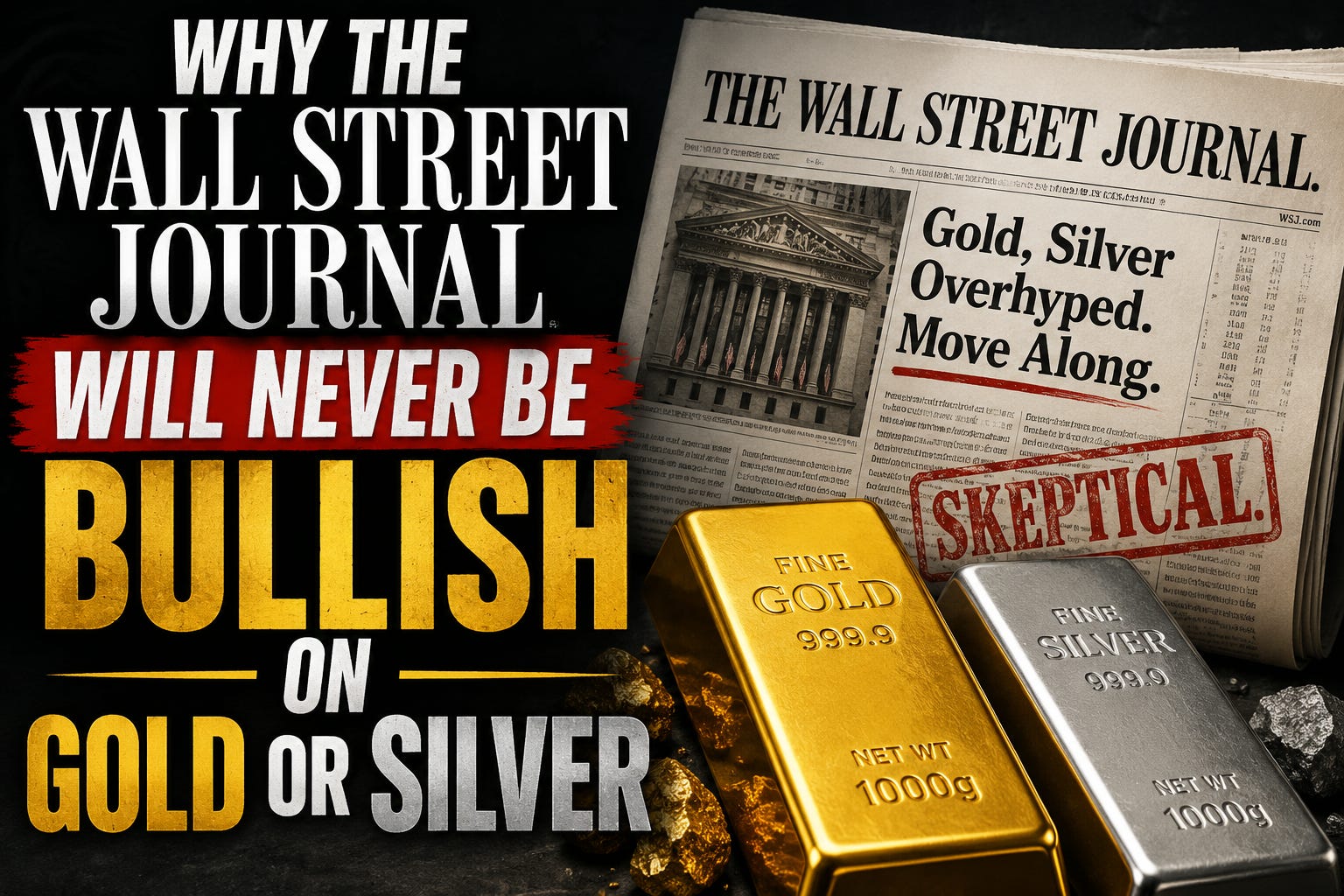
Why the Wall Street Journal Will Never Be Bullish on Gold or Silver

Every few months, gold or silver rips higher, and every few months the Wall Street Journal runs the same piece: a skeptical think-tank economist explaining why “this time isn’t different,” a chart showing gold’s “poor risk-adjusted returns” versus the S&P 500, and a closing paragraph reminding readers that metals pay no dividend. Rinse, repeat. It’s not an accident. It’s structural.
FSN just turned 15. For a limited time, get 35% off a Financial Survival Network subscription — the analysis the WSJ won’t run, delivered straight to your inbox. Claim 35% off here →
1. The Paper Was Built to Sell Paper
The WSJ exists to serve the capital markets ecosystem — brokerages, asset managers, investment banks, and the exchanges that list stocks and bonds. Its advertising base and its access-journalism relationships run through Wall Street, not through the bullion dealers of Perth or Zurich. A newspaper that depends on Goldman Sachs, BlackRock, and Fidelity for ad dollars and for the sources it needs on speed dial is never going to run a front-page piece explaining why their entire product line is a historically inferior store of value. Gold and silver don’t buy full-page ads. Vanguard does.
2. Metals Compete With the Dollar, and the Dollar Signs the Paychecks
Gold’s oldest job is being a referendum on fiat currency. Every dollar that flows into bullion is implicitly a vote of no confidence in the Fed, the Treasury, and the dollar-based financial order that the WSJ’s entire worldview is built around. A financial press that draws its authority from being the dollar system’s paper of record has an existential stake in never legitimizing the asset class whose entire reason for existing is distrust of that system.
3. Access Journalism Requires Staying Onside
Fed governors, Treasury officials, and bank CEOs don’t grant interviews to reporters who’ve been writing “the dollar is being debased and gold proves it.” The WSJ’s beat reporters need continued access to the same rotating cast of central bankers and CFOs. Being reliably dismissive of gold is the price of admission to that Rolodex.
4. The “No Yield” Argument Is a Feature of the Narrative, Not an Analysis
The standard WSJ line — gold pays no dividend, no coupon, no yield — is true and also beside the point. Insurance doesn’t pay a dividend either. Nobody complains that their homeowner’s policy has “underperformed the S&P” for the last decade it wasn’t needed. Gold and silver are priced for the moment confidence breaks, not for the decades when it doesn’t. A press corps whose bonus pool depends on continued faith in equities and bonds has no incentive to run that framing.
5. Institutional Memory Is Short and Selective
When gold ran from $250 to $1,900 in the 2000s, or silver went vertical in 2011, WSJ coverage treated it as a bubble story in real time and a “predictable mean reversion” story in hindsight. Compare that to the multi-decade patience the same paper extends to tech stocks through multiple 80% drawdowns. The benefit of the doubt is not evenly distributed, and it never will be, because doubt is reserved for the asset class that doesn’t buy banner ads.
The Bottom Line
The WSJ isn’t lying, exactly — it’s reporting from inside a system that has a vested interest in the permanence of that system. Expecting the paper of Wall Street record to be bullish on the asset that exists specifically to hedge against Wall Street’s excesses is like expecting a steakhouse menu to recommend the vegan place down the block. It’s not going to happen, and understanding why is more useful than being surprised by it every single time gold makes a new high.
Same Force. Opposite Sign.
All true, except "The standard WSJ line — gold pays no dividend, no coupon, no yield — is true" It's not: a gold owner can write juicy out of the money future calls and pocket the premium- a hedge if gold price goes down, and added profit if it goes up and he settles by selling his gold and settling the contract.
When printed newspapers and media could not be effectively capitalized online they all told pushed agenda of highest payer $. Most media hopped on green agenda money and social program pushers. Propaganda peddlers