
Watch What He Does, Not What He Says: Why Trump Will Never Tell You the Real Story
I’ve got a rule. Been using it on every call I’ve made since early 2025 — Iran, China, Russia, the economy, doesn’t matter — and it’s gone 8-for-8, maybe 10-for-10 depending how generous you want to be counting: don’t lift intentions, look at incentives.
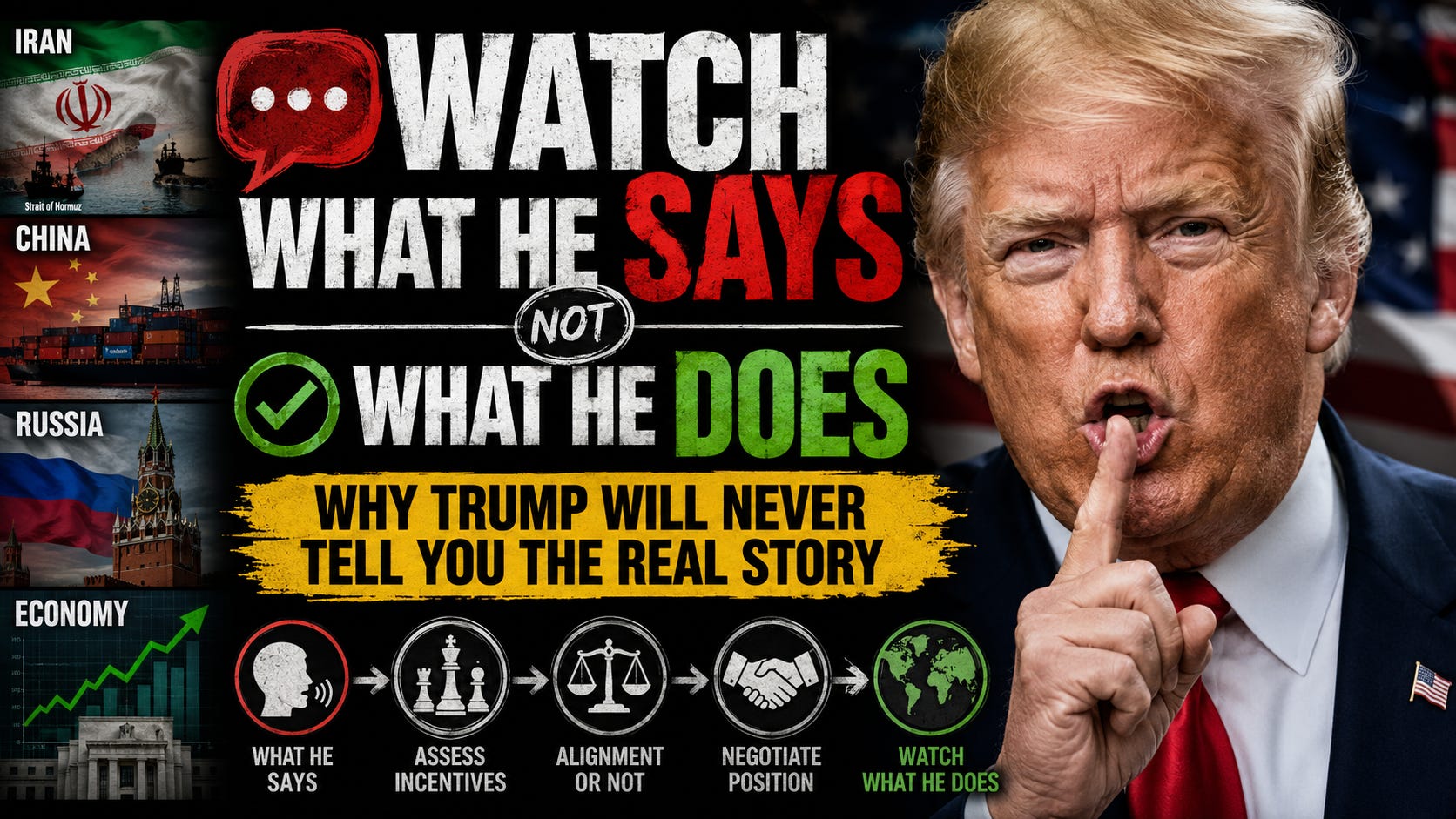
I want to be precise about this, because people always get it wrong. Trump doesn’t lie. Not in the way most people use that word. He speaks in untruths — that’s a big difference that matters when you’re trying to trade or invest off what he says. A lie is when somebody sets out to deceive you. An untruth is a negotiating move that happens to be dressed up as a sentence. If you grade him on accuracy you’ll constantly be wrong and come to despise him, which you might do anyway. Grade him on incentive-alignment and suddenly the guy makes total sense, even when he doesn’t.
I’ve watched this operator for over 40 years so I feel qualified in making these observations. Not from a cable news chair — as an NYC developer, in a city where everybody’s incentives sit right out on the table whether they want to admit it or not. And what I learned watching him that long is simple. He knows his own incentives cold (what he’s after), every time, no exceptions. And he does the homework on the other guy’s incentives just as hard. Everything he says publicly comes after that math, not instead of it.
So here’s the decoder ring, and once you have it you can’t unsee it. “Lying scum” isn’t him telling you someone’s a liar. It’s him telling you their incentives can never line up with his — period, done, don’t bother looking for the deal. “Great leader,” like he says about Erdoğan? It’s not a character reference. It means the incentives are aligned, right now, on whatever’s on the table. Swap out the personality read for the alignment read and the noise disappears.
Iran: the Hormuz Head Fake
The public framing was confrontation, and Trump’s language on Tehran was as hostile as it gets. That hostility was the tell, not the story. He knew from the start that his incentives could never align with the regime’s — there was no deal shape where both sides came out ahead, so the rhetoric ran hot because the alignment was permanently at zero. If you tracked the moves, what actually played out looked more like a corporate hostile takeover play — position, pressure, extract terms, avoid the war everyone assumed was coming. I called this early and it held up call after call, because the incentive structure never supported the maximalist rhetoric even when the words did. Nobody wanted the Strait actually closed. The Kurdish front mattered more as leverage than as ideology.
China gets the same treatment, and so does Russia
Forget the speech. Watch what actually crosses a border. What gets sanctioned, what gets a carve-out, what quietly gets re-routed through a third country when nobody’s supposed to notice — that’s the real transcript. Tariff threats are opening bids dressed up as policy. Sanctions exemptions tell you exactly who still needs to eat, and who Trump’s decided he still needs something from. Russia’s no different, just a slower negotiation with more theater built in on both sides.
The economy runs on the exact same logic, markets, tariffs, Fed pressure, all of it. Skip the announcement and ask who actually benefits if the stated policy happens exactly as described. Nine times out of ten that question alone tells you whether you’re looking at real policy or just a bargaining chip somebody’s floating to see who blinks.
None of this is really about Trump specifically. It’s about incentives being the only honest narrator in the room. He just happens to be loud and inconsistent enough in public that the gap between what he says and what he does is wider than most operators, which makes him an excellent example. The real story was never hidden — it’s sitting right there in the sequence of what happens *after* the statement, once you stop mistaking the statement for the plan.
I’ll say it the way I’ve been saying it since early 2025: follow the incentives, not the adjectives. His big mouth is for the audience in the room. His incentives, announced or unannounced will dictate his final actions.
"A lie is when somebody sets out to deceive you. An untruth is a negotiating move that happens to be dressed up as a sentence."
When you're writing an apology for someone who is fundamentally dishonest, you're not in a good place. This isn't about Trump specifically; this extends to all men who have ambitions of power. Our time is one in which deception, dishonesty and disingenuousness are extolled, even eulogised. Trump is a symptom of our time. People writing in admiration of him and of his kind ought to more mindful of their own moral compass.
You seem to understand the incentives, which means you must also know the end game. I would love to hear what you think Trump wants to accomplish.
Also, you seem to think that Trump can manipulate Netanyahu and Zelenskyy better than the globalist nut jobs who have no conscience or soul, which makes them difficult to read. On the other hand, Trump has an ego and does care about the senseless deaths, which makes him easy to manipulate.
Trump has lost the propaganda wars in Ukraine and Iran and he seems petrified to put Netanyahu and Zelenskyy in their place. Also, the fact he doesn’t come clean over Epstein and Operation Warp Speed, that gave Big Pharma immunity and needlessly killed millions and destroyed millions of small businesses means he has lost the confidence needed for folks to follow him blindly.
Trump has perpetuated the lies behind Ukraine, Iran, Covid, Epstein, and he appears ignorant of the Keynesian models that dictate the Fed and the roll confidence plays in the economy. Everything he is DOING is reducing confidence because people are calling BS on the rhetoric.